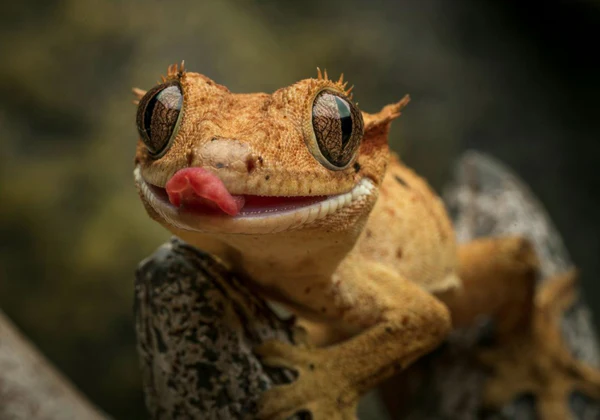
🌿 Natural Habitat
Crested geckos are native to the southern end of Grande Terre and the Isle of Pines in New Caledonia. They inhabit humid subtropical forests, living in the lower and mid-canopy of shrubs and small trees. The climate there is warm year-round with high humidity and a distinct dry season.
Understanding their origin helps set realistic expectations: they don't need extreme heat, they thrive in moderate temperatures, and they appreciate vertical climbing space.
🏠 Housing
A single adult requires a minimum of a 45 × 45 × 60 cm (18" × 18" × 24") front-opening terrarium. Taller is always better — these are arboreal animals that spend most of their time off the ground. Juveniles can be temporarily housed in smaller enclosures, but upgrade as they grow.
Provide plenty of vertical climbing structure: cork bark tubes, driftwood, bamboo, and dense live or artificial plants such as pothos, bromeliads, and Sansevieria. A bioactive substrate (organic topsoil + coconut coir) helps maintain humidity and supports a clean-up crew of isopods and springtails.
🌡️ Temperature & Humidity
Crested geckos are one of the few reptiles that thrive at room temperature. They do not require supplemental heating in most homes.
Mist one side of the enclosure once or twice a day to create a humidity gradient and allow the enclosure to dry out between mistings. A digital thermometer/hygrometer is essential.
🍽️ Diet & Feeding
The core of a crested gecko's diet should be a complete meal replacement powder (MRP) such as Repashy Crested Gecko Diet or Pangea Fruit Mix Complete. Mix with water to a ketchup-like consistency and offer in a small dish every other evening — remove uneaten food after 24–36 hours.
Supplement 1–2 times per week with live insects: small crickets, dubia roaches, or black soldier fly larvae (BSF). Dust prey with calcium (without D3) at every feeding, and a vitamin/calcium-with-D3 supplement every 2 weeks. Always gut-load feeders before offering.
Fresh water should be available at all times in a shallow dish, and the misting routine also allows geckos to drink droplets from leaves.
🤝 Handling & Temperament
Crested geckos are generally calm and tolerate handling well once acclimated. Allow a new gecko 2–4 weeks to settle in before regular handling. Start with short sessions (5–10 minutes) and let the gecko walk from hand to hand rather than gripping it.
They may jump unexpectedly — always handle close to a surface or over a bed/sofa. Like all Rhacodactylinae relatives, they can drop their tail if severely stressed; unlike their cousins, crested geckos do not regenerate their tail. A tail-less gecko is healthy and unharmed.
❤️ Health
Metabolic Bone Disease (MBD) is the most common preventable condition, caused by calcium/D3 deficiency. Using a complete MRP and supplementing properly prevents this.
Retained shed can occur in low humidity — ensure the enclosure has a moist hide or adequate humidity. Incomplete shed on digits or eyes should be gently loosened with a damp cotton swab.
Floppy Tail Syndrome occurs when a gecko repeatedly sleeps head-down against glass, causing the tail to flop to one side. Add more horizontal perches to prevent this.
Find a reptile-experienced vet before you need one. Annual check-ups and fecal parasite tests are good practice.