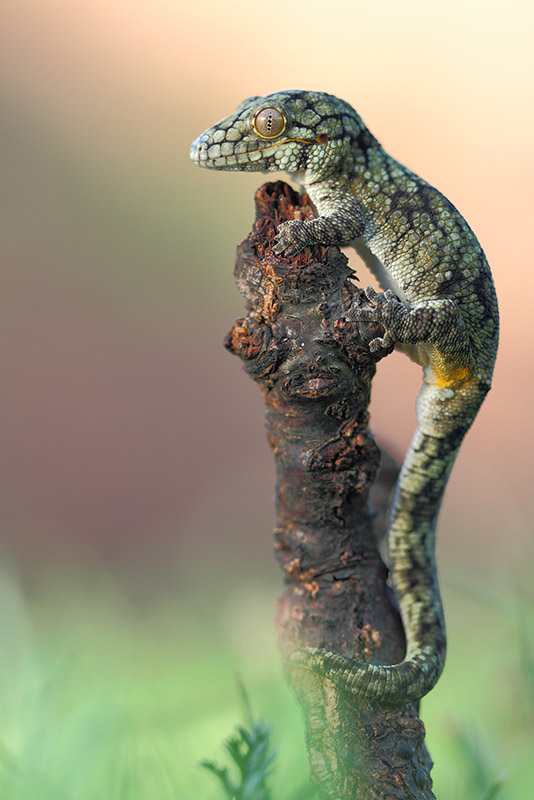
🌿 Natural Habitat
Eurydactylodes agricolae inhabits the humid rainforests and gallery forests of New Caledonia, where it lives among dense vegetation, mossy branches, and leaf litter at low to mid-canopy levels. The name agricolae (Latin: "of the farmers") reflects historic collection sites in agricultural zones near original forest.
These are very small, cryptic geckos — masters of camouflage and stillness. In the wild they rely on blending into bark and moss rather than fleeing from predators. This shapes everything about how they should be housed: complex, naturalistic enclosures where they can feel hidden are not optional, they are essential for the animal's wellbeing.
🏠 Housing
Despite their small size, E. agricolae should not be kept in minimal enclosures. A 30 × 30 × 45 cm (or larger) well-planted terrarium is appropriate for a single adult. A pair can be housed together, but monitor carefully for stress or aggression.
A bioactive setup is strongly recommended: organic topsoil and coir substrate, live mosses (Ficus pumila works well), climbing vines, cork bark flats and tubes, bamboo, and dense plants such as bromeliads and Peperomia spp. The enclosure should feel like a micro-jungle. A thriving population of isopods and springtails manages waste and keeps conditions stable.
Avoid frequent disturbance. These geckos are easily stressed — choose a low-traffic location and resist the urge to rearrange the enclosure.
🌡️ Temperature & Humidity
Eurydactylodes are more sensitive to temperature extremes than the larger New Caledonian species. They prefer cooler conditions and will quickly become stressed above 26 °C.
High, stable humidity is critical. Mist the enclosure thoroughly each evening, but ensure adequate ventilation so the substrate can breathe — stagnant wet conditions cause respiratory infections and mould. A mix of solid and mesh panels on the enclosure top helps dial this in. Live moss acts as a natural humidity buffer.
🍽️ Diet & Feeding
Eurydactylodes are primarily insectivorous. Unlike crested and gargoyle geckos, they do not readily accept fruit-based MRPs as a dietary staple, though some individuals will occasionally lick a small amount.
Offer a variety of small live insects 3–4 times per week: micro-crickets, small dubia roaches, fruit flies (Drosophila hydei or D. melanogaster depending on age), and small waxworms as an occasional treat. Prey items should be very small — no wider than the gecko's head.
Dust prey with calcium without D3 at every other feeding. Use a calcium-with-D3 + vitamin supplement once every 1–2 weeks. Gut-load all feeder insects with quality vegetables and commercial gut-load products.
Because this species is secretive, feeding is best observed without directly watching — place prey and step away. Check for insects in the morning; remove any that were not consumed.
🤝 Handling & Temperament
E. agricolae is not a handling species. While individuals vary, these geckos are fragile, easily stressed, and have evolved to depend on camouflage rather than tolerating contact. Frequent or prolonged handling can cause chronic stress, suppressed immune response, and refusal to feed.
Observe and appreciate them through the enclosure glass. Interact with the enclosure only for maintenance (feeding, spot cleaning, plant care) — keep sessions brief and calm. A gecko that rarely sees human hands is a healthier, longer-lived gecko.
If you do need to move an animal, use a soft, slow scoop rather than grabbing. Never restrain the tail.
❤️ Health & Considerations
Stress is the primary health risk for this species. A gecko that hides constantly, does not eat, or loses weight is almost always a stressed gecko. Review temperatures, humidity, enclosure mates, disturbance frequency, and hide availability before assuming illness.
Dehydration is a concern if humidity drops. Signs include sunken eyes, wrinkling skin, and stuck shed. Increase misting and add a small, shallow water dish near ground level.
Cryptosporidiosis and internal parasites should be screened via fecal testing for any newly acquired animal. Quarantine for a minimum of 90 days — ideally longer for such a sensitive species — before introducing to any collection.
Because captive data on this species is limited, finding a reptile vet with exotic species experience before you acquire the animal is essential, not optional. The small captive population means any health issues you encounter may lack documented treatment protocols.
Sourcing: only acquire captive-bred animals from reputable breeders. Wild-caught specimens rarely thrive in captivity and their collection puts pressure on an already small and localised wild population.