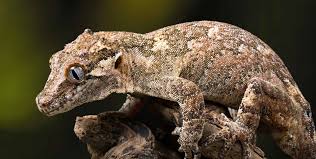
🌿 Natural Habitat
Gargoyle geckos are endemic to the southern tip of Grande Terre, New Caledonia. They inhabit scrublands and forest edges rather than the dense primary forest preferred by crested geckos. They are semi-arboreal — spending time both in low shrubs and on the ground among leaf litter and rocks.
This terrestrial tendency means they benefit from more horizontal floor space and ground-level hides compared to purely arboreal species.
🏠 Housing
Adults do well in a 45 × 45 × 60 cm front-opening terrarium at minimum, though a wider footprint (60 × 45) is preferable given their semi-terrestrial nature. Unlike crested geckos, they benefit more from floor space, though they do climb and perch readily.
Furnish with a mix of ground-level cork flats, leaf litter, and low horizontal branches, plus vertical elements like cork rounds and sturdy plants. A deep, moisture-retaining substrate such as coconut coir mixed with topsoil works well. Gargoyle geckos can be kept in bioactive setups and will benefit from a clean-up crew.
Do not house multiple males together — they are territorial and will fight. Male-female pairs should only be co-housed intentionally for breeding, with careful monitoring.
🌡️ Temperature & Humidity
Gargoyle geckos share similar climate requirements with crested geckos — moderate temperatures and good humidity. They can tolerate slight cooler temps, which can be useful for triggering breeding behaviour.
Mist one side of the enclosure each evening. Gargoyle geckos appreciate a humid hide at ground level — a plastic container with a lid and damp sphagnum moss works perfectly.
🍽️ Diet & Feeding
Like crested geckos, gargoyle geckos thrive on a complete MRP (Repashy, Pangea, or similar) as a dietary staple. Offer a fresh portion every other evening, removing uneaten food after 24 hours.
Gargoyle geckos tend to eat more insects in the wild than crested geckos, so a higher frequency of live prey is beneficial — 2–3 times per week. Offer crickets, dubia roaches, BSF larvae, or waxworms as an occasional treat. All prey should be gut-loaded and dusted with calcium.
Adults can take larger prey items than crested geckos of similar size. Avoid feeding prey wider than the space between the gecko's eyes.
🤝 Handling & Temperament
Gargoyle geckos have a reputation for being nippy as juveniles, but most calm down considerably with regular, gentle handling. They are generally more defensive than crested geckos, especially when young.
Approach from the side rather than above (which mimics a predator attack). Let the gecko set the pace — short, daily handling sessions build trust faster than infrequent long ones.
Unlike crested geckos, gargoyle geckos can regenerate a dropped tail, though the regrown version will look different — typically smooth and sausage-like compared to the original. Tail drops are a defence mechanism and cause no lasting harm.
❤️ Health
MBD is preventable with proper diet and supplementation. Follow the same calcium/D3 regime as for crested geckos.
Bite wounds are a concern if housing two geckos together. Check enclosure-mates regularly for wounds, especially around the tail base and head. Separate immediately if injuries are found.
Cryptosporidiosis (crypto) is a parasitic infection that can affect all Rhacodactylus species. Quarantine any new animal for at least 90 days and test with a fecal panel before introducing to existing animals or sharing equipment.
Retained shed around digits and eyes is managed the same way as with crested geckos — improve humidity and assist gently with a damp swab if needed.